


15.06.2026
arrtourist - Interview with Hans Keist and Patrick Lambertz (Managing Partners of ALPA of Switzerland AG)
Interview conducted by Kai Geiger for arttourist magazine LOUISE
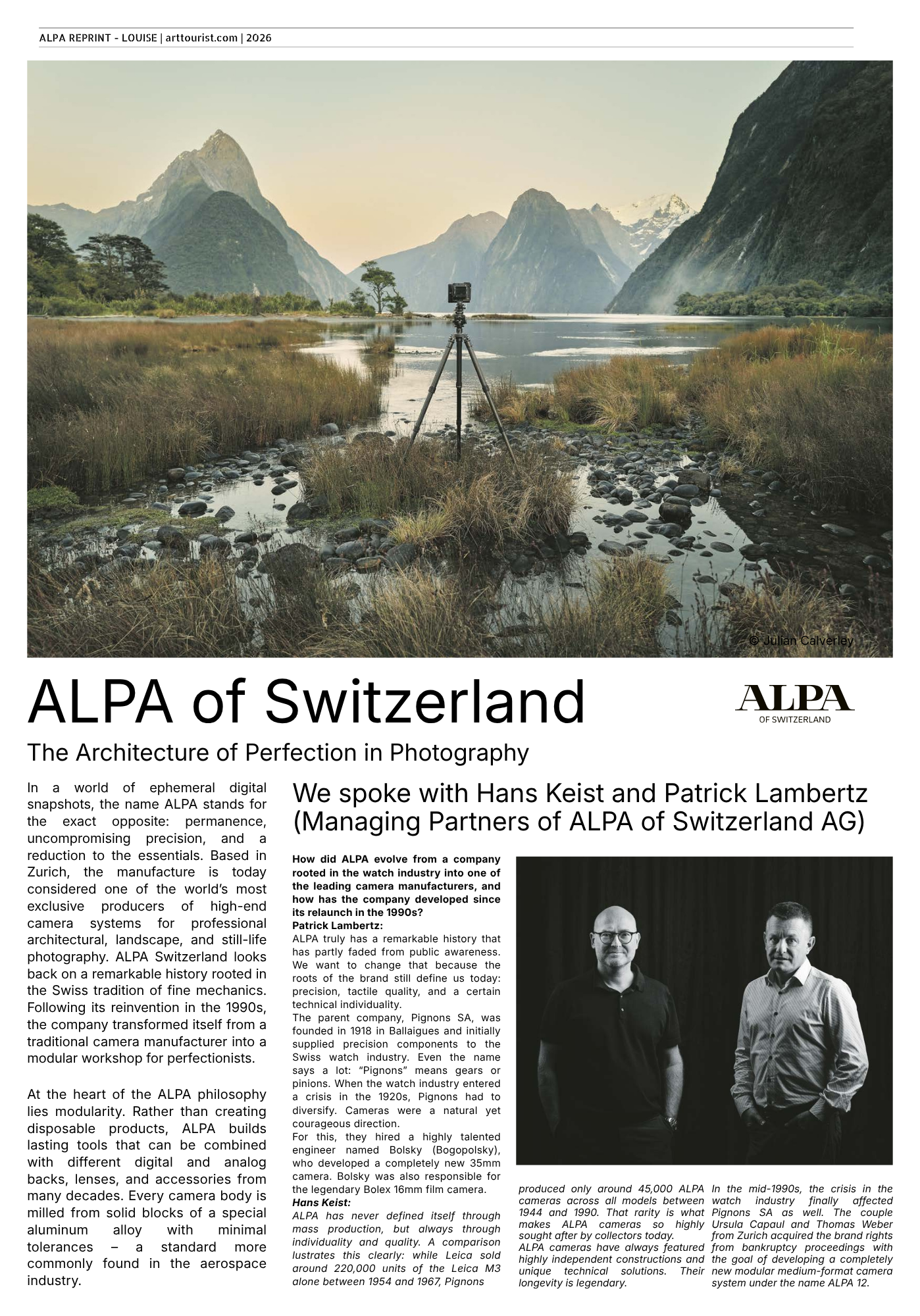
The Architecture of Perfection in Photography
In a world of ephemeral digital snapshots, the name ALPA stands for the exact opposite: permanence, uncompromising precision, and a reduction to the essentials. Based in Zurich, the manufacture is today considered one of the world’s most exclusive producers of high-end camera systems for professional architectural, landscape, and still-life photography. ALPA Switzerland looks back on a remarkable history rooted in the Swiss tradition of fine mechanics. Following its reinvention in the 1990s, the company transformed itself from a traditional camera manufacturer into a modular workshop for perfectionists.
At the heart of the ALPA philosophy lies modularity. Rather than creating disposable products, ALPA builds lasting tools that can be combined with different digital and analog backs, lenses, and accessories from many decades. Every camera body is milled from solid blocks of a special aluminum alloy with minimal tolerances – a standard more commonly found in the aerospace industry.
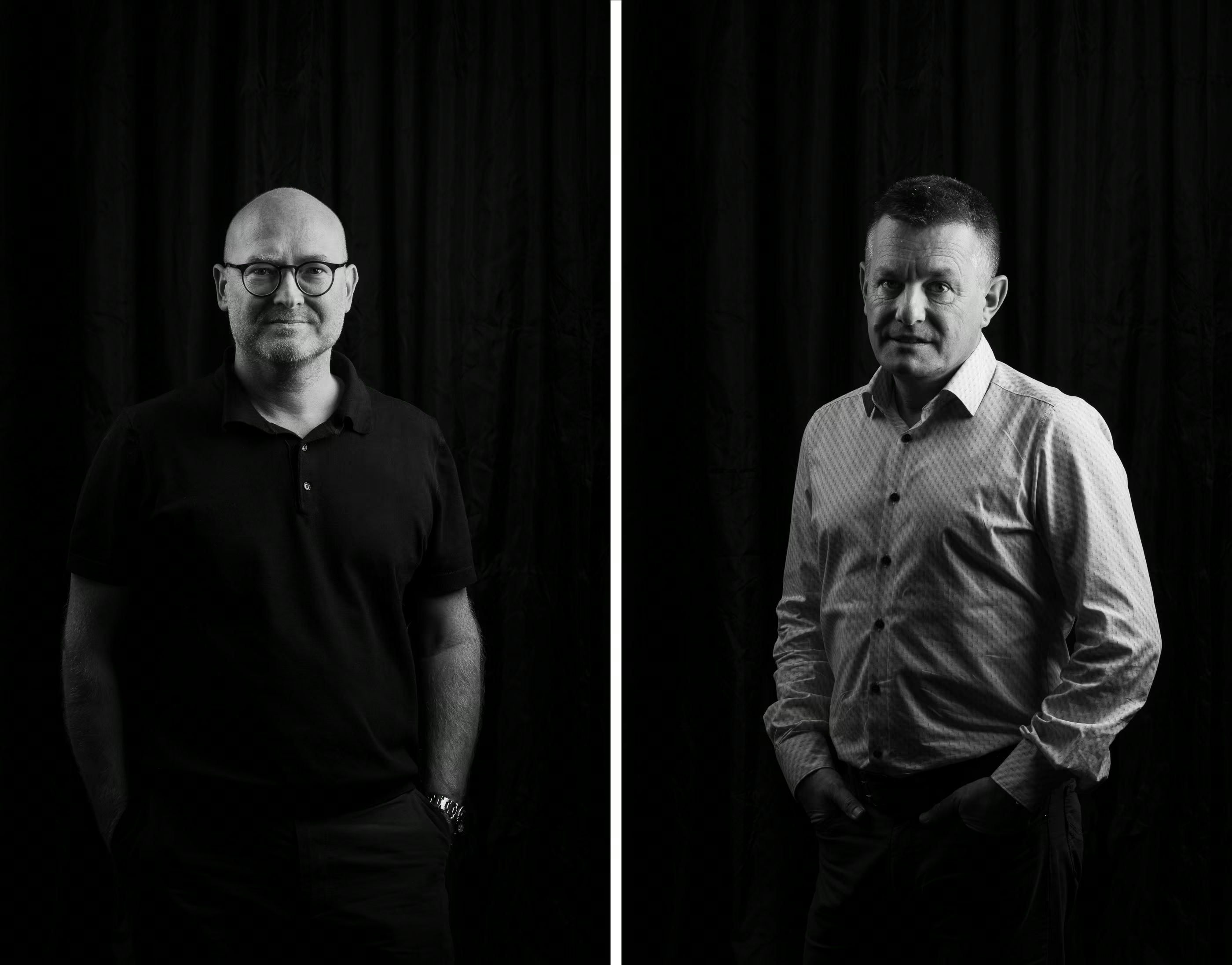
We spoke with Hans Keist and Patrick Lambertz (Managing Partners of ALPA of Switzerland AG).
How did ALPA evolve from a company rooted in the watch industry into one of the leading camera manufacturers, and how has the company developed since its relaunch in the 1990s?
Patrick Lambertz:
ALPA truly has a remarkable history that has partly faded from public awareness. We want to change that because the roots of the brand still define us today: precision, tactile quality, and a certain technical individuality.
The parent company, Pignons SA, was founded in 1918 in Ballaigues and initially supplied precision components to the Swiss watch industry. Even the name says a lot: “Pignons” means gears or pinions. When the watch industry entered a crisis in the 1920s, Pignons had to diversify. Cameras were a natural yet courageous direction.
For this, they hired a highly talented engineer named Bolsky (Bogopolsky), who developed a completely new 35mm camera. Bolsky was also responsible for the legendary Bolex 16mm film camera.
Hans Keist:
ALPA has never defined itself through mass production, but always through individuality and quality. A comparison illustrates this clearly: while Leica sold around 220,000 units of the Leica M3 alone between 1954 and 1967, Pignons produced only around 45,000 ALPA cameras across all models between 1944 and 1990. That rarity is what makes ALPA cameras so highly sought after by collectors today.
ALPA cameras have always featured highly independent constructions and unique technical solutions. Their longevity is legendary.
In the mid-1990s, the crisis in the watch industry finally affected Pignons SA as well. The couple Ursula Capaul and Thomas Weber from Zurich acquired the brand rights from bankruptcy proceedings with the goal of developing a completely new modular medium-format camera system under the name ALPA 12.
After a somewhat difficult beginning, the system found many passionate followers and became the preferred instrument of demanding architectural and studio photographers – increasingly also among internationally renowned contemporary artists.
I took over the company in 2022 because there was no family successor within Capaul and Weber’s ownership structure. Patrick Lambertz joined the management team in March 2025. Together with our team, we want to lead the brand and these unique products into the future.
What role does the Swiss tradition of precision play in your products?
Patrick Lambertz:
For us, Swiss precision is not simply a label printed on packaging. It is embedded in the way our products are made, how they feel, and how long they last.
ALPA 12 products have been produced for over thirty years with our trusted Swiss partners. You notice it immediately in the tactile experience. Anyone who has held an ALPA in their hands never forgets the feeling.
For us, Swissness is also reflected in sustainability. We recently welcomed Simon Depardon, the son of French Magnum photographer and first ALPA 12 customer Raymond Depardon. Simon brought his father’s 30-year-old analog ALPA 12 WA and asked whether it could also be used digitally.
With just a few adjustments, we attached a digital back and shutter release – and the camera could immediately be used again at a contemporary technical level. With the original lenses. And of course, it still works perfectly with analog roll film as well.
We preserved the patina, cleaned the camera, replaced a spirit level, and it was fully operational again. To us, that is Swissness: not nostalgia, but the ability to keep a tool alive for decades.
Your cameras are often described as “tools” or “instruments.” What does that mean in practice?
Hans Keist:
The word “instrument” beautifully expresses that one develops more than a purely functional relationship with an ALPA. Similar to a musical instrument, you spend time learning and mastering it. Over time, you develop a certain dexterity – and even speed – in handling it.
That can be deeply satisfying because it gives you maximum control over the result. Many modern cameras automate countless processes, which is wonderful in many situations. But with experience, many photographers realize they want to reduce that distance again. They no longer want merely to press the shutter – they want to decide.
An ALPA is purist in that sense. It does not force you to slow down, but it invites awareness. Perhaps it can be compared to a high-end audio system or even a Stradivarius violin. What matters is not only what it can technically achieve, but what it does to you. You are rewarded with an authentic experience and result.
Which technological developments in photography do you currently consider most relevant?
Patrick Lambertz:
From our perspective, the camera industry has reached a point where pure technical specifications no longer determine everything. Many systems today operate at an extremely high level. Performance has become a commodity.
With medium-format digital backs and world-class optics, ALPA still occupies the reference class in image quality. Yet among participants of our ALPA Escapes, we increasingly observe that other questions are becoming more important:
Does a camera inspire me to go out and photograph?
Does it make me look more carefully?
Does it challenge me to improve?
Does it give me more control – or take control away from me?
In a time when we increasingly surrender control, an ALPA is almost a counterproposal: a tool that places the photographer back at the center. It helps turn off the autopilot and encourages more conscious seeing and creating.
At the same time, we are convinced that personal relationships with artists and photographers are becoming increasingly important. Technology alone is not enough – environment, mindset, and dialogue matter just as much.
What role does digitalization play in this context?
Patrick Lambertz:
When we speak about image capture and post-processing, digitalization is ultimately just another way of capturing and making light visible – nothing more and nothing less.
As a student, I built a darkroom without proper ventilation, which made me very sensitive to chemicals. Eventually, analog lab work became physically impossible for me. When digital photography matured, it felt like liberation.
I still love and practice analog photography – it has its own unmistakable charm. But digitalization, including digital post-production, offers possibilities I would no longer want to miss, even when working with analog negatives.
For me, analog and digital are not ideological opposites. They are simply two different ways of working with light and time.
How will AI and rapidly advancing technology change photography? Will cameras disappear?
Hans Keist:
Nobody can answer that with certainty today. But it is obvious that AI will fundamentally transform image creation.
In some areas of applied photography, AI will inevitably play a major role for economic reasons. If an image mainly needs to deliver a certain atmosphere, surface, or backdrop, AI will often be faster and cheaper. Certain commercial image worlds may therefore partially or fully move in that direction.
At the same time, we believe this could increase the importance of genuinely photographed images. Demanding brands, artists, and collectors may increasingly ask:
Was this image generated – or was someone actually there?
Did someone truly see, decide, wait, and work for this image?
Growing skepticism toward artificial authenticity may lead to a renewed appreciation for real photography. From our perspective, the camera will not disappear. But it may once again become a consciously chosen instrument rather than an everyday commodity.
Is technology or creativity more important — or are they inseparably connected?
Hans Keist:
Creativity is the spark that unfolds through the meaningful use of technology. Technical innovation often enables entirely new ways of seeing. They may not be inseparable, but they certainly exist in an open and fruitful relationship with one another.
Who are your customers?
Patrick Lambertz:
Our customers are as diverse and individual as our cameras. They include professional photographers and demanding enthusiasts. World-famous artists, architects, designers, and entrepreneurs from all over the world.
What unites them is their relationship to photography and their desire – perhaps even compulsion – to express themselves through images. Many publish books or hold exhibitions.
We see ourselves as a hub. We connect people and facilitate relationships: with galleries, publishers, clients, curators, and technical specialists. We do not see our customers as the endpoint for our cameras, but as the beginning of a relationship that often lasts decades and evolves into a dense network of professional and personal friendships.
And you do not leave friends standing in the rain with a technical problem.
Why do professionals consciously choose manual high-end cameras instead of automated systems?
Patrick Lambertz & Hans Keist:
We would not generalize it that way. It depends greatly on the intended application whether one chooses a highly automated system or a manual high-end camera. There are many valid reasons for automated systems, and most ALPA owners own more than one camera.
An ALPA is not the right camera for every task – and perhaps that is precisely part of its strength. It does not need to do everything; it only needs to do what it was built for exceptionally well.
From those who consciously choose ALPA, we repeatedly hear similar reasons: flexibility, modularity, build quality, tactile experience, service, and personal relationships with us. Sometimes the brand image also plays a role. But ultimately, it is usually the combination of precision, reduction, and control that makes the difference.
How important are partnerships with artists and storytelling within ALPA’s marketing?
Patrick Lambertz:
Our collaborations with artists take many forms. What matters most is that the people we work with genuinely use ALPA out of conviction.
As a boutique manufacturer, we do not have the margins to distribute products broadly for promotional purposes. And doing so would damage credibility. We do not want artificial testimonials. The artists featured on our website use ALPA because they truly believe in it – and in most cases, they purchased their equipment themselves.
Hans Keist:
Regarding storytelling: during the Capaul & Weber era, ALPA communicated very quietly. The cameras were almost passed from connoisseur to connoisseur like a secret recommendation. That contributed significantly to the cult status of the products, but naturally limited broader awareness.
Patrick Lambertz:
Yet there are countless fascinating stories surrounding ALPA – about photographers, artists, projects, technical solutions, and cameras that return to our workshop decades later.
We want to make this knowledge more visible.
We aim to make the quality and premium nature of the products more tangible – from the website to the packaging. Not louder, but clearer. Not more artificial, but closer to what ALPA truly represents.
What personally fascinates you about photography and camera technology?
Patrick Lambertz & Hans Keist:
What fascinates us is that photography is never only technology and never only emotion. It exists precisely between the two. You work with light, time, space, material, and decisions.
Photography is fundamentally about attention. You must truly engage with a place, an object, or a person. Sometimes the image already exists – but you only see it once you slow down.
That is why camera technology only becomes interesting to us when it does not replace decisions, but sharpens them. A good camera should not stand between the photographer and the subject. It should become an extension of thought.
Perhaps that is also why we prefer to speak about instruments. An ALPA does not try to outsmart the photographer. It is a highly precise counterpart. You work with it. And when everything aligns – camera, lens, light, concentration – a special kind of craftsmanship-driven joy emerges.
Many of our customers know and appreciate exactly that feeling.
What makes a “perfect” image for you?
Patrick Lambertz & Hans Keist:
The perfect image probably does not exist – and that is exactly why we continue searching for it.
Technically, many things can be controlled: sharpness, perspective, tonal values, color, output. But ultimately, a photograph requires something that cannot be fully controlled.
For us, perfection is therefore not the same as flawlessness. Of course, we love precision – otherwise we would not build ALPA cameras. But precision alone does not create a meaningful image. What matters is whether an image possesses presence.
There are images that are technically flawless yet remain empty. And there are images with a slight tension, a subtle imperfection, something unexpected – and precisely because of that, they become powerful.
Perhaps an image becomes truly special when it is both clear and open at the same time. When you sense that someone made very conscious decisions, yet the image still does not require explanation. It possesses its own silence, its own tension.
That interests us more than perfection in the literal sense.
A strong image does not remain only on paper or on a screen. It continues to work inside the mind.
Interview conducted by Kai Geiger.
About arttourist:
Arttourist.com is a specialized online magazine and an initiative launched by Kai Geiger, based in Konstanz. The project focuses specifically on cultural tourism and brings together the fields of art, culture, festivals, design, and travel.
The Gazette can also be found at art basel and photo basel, which are taking place this June.


Links
Related Photographers

RElated Logs
Related Media Assets
Related Products
Galleries

Überlandstrasse 241
8600 Dübendorf
Switzerland
Phone: +41 44 383 92 22
@2026 all rights reserved

PRECISION MEASURED IN MICRONS. PASSION MEASURED IN DECADES